Squint Service
Advanced diagnosis and treatment for eye alignment problems.
The medical name for squint is strabismus. It is a condition where the eyes do not look together in the same direction. Whilst one eye looks straight ahead, the other eye turns to point inwards, outwards, upwards or downwards.
Squints are common and affect about 1 in 20 children. Most squints develop before preschool age, usually by the time a child is three years old.
Sometimes a child with a squint may stop using the affected eye to see with. This can lead to visual loss called amblyopia, which can become permanent unless treated early in childhood.
Squints can also develop in older children or in adults.
What Causes Squint?
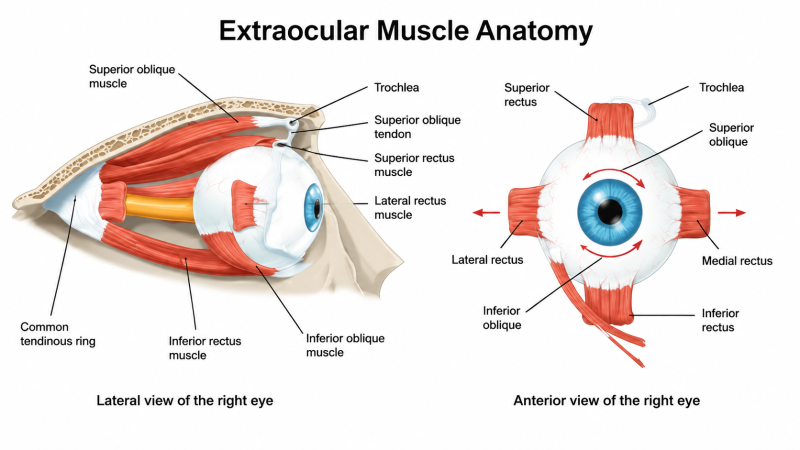
A squint develops when the eye muscles do not work in a balanced way and the eyes do not move together correctly.
Yes, there are different types of squint. Squints can be divided into different categories:
- By the direction of the squinting (turning) eye: in, out, up or down.
- Constant or Intermittent.
- Manifest or latent.
- Concomitant or incomitant i.e., whether the severity (angle) of the squint is the same in all directions or not.
What are the types and causes of squint in children?
About 5 in 100 children aged five years old have a squint. Babies sometimes cross their eyes - it is quite normal for this to happen occasionally, especially when they are tired.
- Congenital squints of unknown cause.
- Squint related to refractive errors.
- Other Cause.
In some cases, a squint is one feature of a more generalised genetic or brain condition. Squints can occur in some children with cerebral palsy, Noonan's or Down's syndrome, hydrocephalus, brain injury or tumour, retinoblastoma and several other conditions.
Amblyopia
Amblyopia is sometimes called a lazy eye. It is a condition where the vision in an eye is poor and it is caused by lack of use of the eye in early childhood.
If amblyopia is not treated before the age of about 7 years, the visual impairment usually remains permanent. A squint is the most common cause of amblyopia.
The turned eye then fails to develop the normal visual pathways in childhood and amblyopia develops in this eye.
How the squint looks
A squint can be a cosmetic problem. Many older children and adults who did not have their squint treated as a child have reduced self-esteem because of the way their squint looks to other people.
Impaired binocular vision
This means the child does not have a good sense of depth when looking at objects. As a result, he or she cannot see properly in three dimensions.
How is a squint diagnosed and assessed?
It is important to diagnose a squint (and amblyopia) as early as possible. Routine checks to detect eye problems in babies and children are usually done at the newborn examination and at the 6- to 8-week review.
Any squint seen in a newborn baby should always be intermittent (come and go), reducing by 2 months of age, and gone by 4 months of age.
What are the treatments for squint?
Treatment typically involves the following:
- Occlusion: Treating amblyopia (visual loss) if this is present by patching.
- Optics: Wearing glasses to correct any refractive error.
- Orthoptic Exercises.
- Operation: Surgery is often needed to correct the appearance of the squint itself.
Surgery
In many cases an operation is advised to make the eyes as straight as possible. The main aim of surgery is to improve the appearance of the eyes.
In some cases, surgery may also improve or restore binocular vision.
Botulinum toxin
Botulinum toxin (also known as Botox®) stops muscle cells from working (it paralyses them). It is used for a variety of conditions where it is helpful to weaken one or more muscles.
In recent years, injections of botulinum toxin directly into eye muscles have been used as a treatment for certain types of squint.